Wife Nancy Witcher Langhorne
Queer Places:
Forest Hills Cemetery and Crematory, Jamaica Plain, Suffolk County, Massachusetts, USA
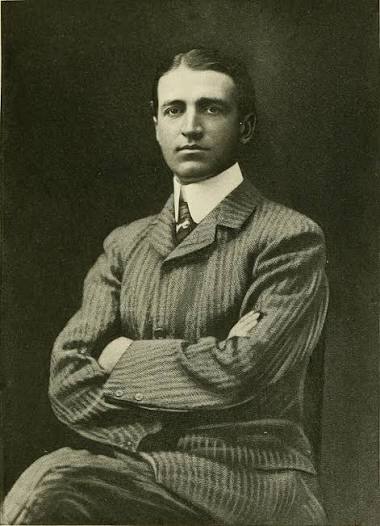 Robert Gould Shaw II (June 16, 1872 – March 29, 1930) was an American socialite, wealthy landowner, and international polo player born into the heart of elite Boston Brahmin
society. A member of a tremendously wealthy family—his grandfather accumulated a fortune through mining and mercantile ventures—Shaw chose a life of leisure, sport, and high
society rather than corporate business. He was an avid polo player with the Myopia Hunt Club on Boston's North Shore and a prominent fixture of Gilded Age opulence. He was
also a first cousin of the famed Robert Gould Shaw, the Union colonel who commanded the 54th Massachusetts Infantry Regiment during the American Civil War.
Robert Gould Shaw II (June 16, 1872 – March 29, 1930) was an American socialite, wealthy landowner, and international polo player born into the heart of elite Boston Brahmin
society. A member of a tremendously wealthy family—his grandfather accumulated a fortune through mining and mercantile ventures—Shaw chose a life of leisure, sport, and high
society rather than corporate business. He was an avid polo player with the Myopia Hunt Club on Boston's North Shore and a prominent fixture of Gilded Age opulence. He was
also a first cousin of the famed Robert Gould Shaw, the Union colonel who commanded the 54th Massachusetts Infantry Regiment during the American Civil War.
Shaw’s personal life was marked by public scandal, severe alcoholism, and profound tragedy:
In 1897, Shaw married Nancy Witcher Langhorne. The volatile marriage lasted only four years before ending in a bitter divorce in
1903. Nancy subsequently moved to England, married Waldorf Astor, and made history as Lady Astor, the first woman to take her seat as a Member of Parliament.
Shaw later remarried to Mary Hannington, with whom he had four sons. His later years were heavily impacted by the collapse of his fortune following the Wall Street Crash
of 1929. He died in New York in March 1930 at the age of 57.
The lives of Shaw's children were similarly fraught with severe personal crises:
Robert Gould Shaw III ("Bobbie"): Shaw and Nancy Astor's only child struggled deeply with his mental health and
alcoholism. In 1931, he was arrested and imprisoned in England for six months for "homosexual offenses" (homosexuality being a criminal offense in Britain at the time).
Plagued by lifelong depression and family tragedies, he died by suicide in 1970.
Louis Agassiz Shaw II: One of Shaw's sons from his second marriage, Louis suffered from severe paranoia and mental illness. In 1964, during a severe psychiatric episode,
he fatally assaulted his maid and spent the remainder of his life institutionalized until his death in 1987.
An intriguing intersection connects Robert Gould Shaw II to the broader tapestry of Gilded Age queer history through art and social networks:
The artist R.G. Harper Pennington painted a striking nude portrait of Robert Gould Shaw II cast as "Little Billee"—one of
the central bohemian artist characters from George du Maurier’s massively popular 1894 novel Trilby.
The painting famously found its way into the private quarters of Henry Symes "Harry" Lehr, a dominant arbiter of Gilded Age
high society in Newport, Rhode Island. Lehr was a closeted gay man in a "lavender marriage" to wealthy socialite
Elizabeth Wharton Drexel. Lehr was rumored to have had a longstanding, intimate relationship with fellow Newport
cottager and friend Charles E. Greenough.
Reflecting the coded aesthetic spaces of wealthy turn-of-the-century gay elites, Lehr kept Pennington’s nude depiction of Shaw hanging prominently in his personal
bedroom, serving as an artifact of both elite homosocial/homosexual homosociality and the homoerotic undertones that periodically surfaced within Gilded Age artistic
circles.
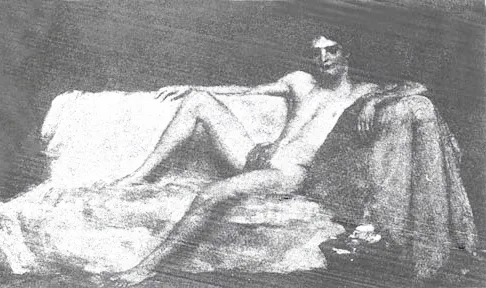
Robert Gould Shaw II as Little Billie from George du Maurier's Trilby
- Du Maurier, George. Trilby. New York: Harper & Brothers, 1894.
- Lehr, Elizabeth Wharton. “King Lehr” and the Gilded Age. Philadelphia: J.B. Lippincott Co., 1935 (including serialized features and accompanying photographic records in Town & Country).
- Pennington, R.G. Harper. Robert Gould Shaw II as "Little Billee". Oil painting / archival photographic documentation (public domain / Wikimedia Commons).
- Vanderbilt, Arthur T. Fortune's Children: The Fall of the House of Vanderbilt. New York: William Morrow and Co., 1989.
Support this project
This website is a passion project researched, developed, and funded entirely by me. If you find the content valuable and would like to help support the ongoing research and hosting costs, any contribution is deeply appreciated.
Thank you for keeping this independent resource alive!
My books on Amazon: Elisa Rolle's books
BACK TO HOME PAGE